
Why SIFS Is 10µs in 2.4 GHz and 16µs in 5 GHz
SIFS is the small time gap a receiving station needs to process a frame (demodulation plus the RX→TX turnaround) before it can send an ACK or response. It looks like SIFS changes between frequency bands, but the real difference comes from the PHY type, not the band.
802.11b and the 10µs SIFS
Legacy 802.11b uses DSSS/CCK modulation, and its SIFS is defined as 10µs. DSSS is relatively simple, with straightforward modulation and signaling, so the receiver doesn't need much processing time before it can reply.
OFDM and the 16µs SIFS
OFDM-based PHYs require more complex processing, such as FFT operations, which take additional time. To accommodate that, the standard defines SIFS as 16µs for OFDM PHYs. So far it lines up neatly: 802.11b in 2.4 GHz uses 10µs, and 802.11a's OFDM in 5 GHz uses 16µs.
The interesting case: 802.11g
802.11g brought OFDM into the 2.4 GHz band, but instead of adopting the 16µs SIFS like 802.11a, it kept 10µs. The reason is backward compatibility: 802.11g had to coexist with 802.11b devices, which only understand a 10µs SIFS. Yet 802.11g still needs 16µs to process a received OFDM frame and reply.
To resolve that mismatch, 802.11g introduced a clever mechanism called Signal Extension (SE). Every OFDM frame in 802.11g carries an extra 6µs of signal (dead air) after the payload, giving the 11g receiver the additional time it needs to process the frame.
10µs SIFS + 6µs signal extension = 16µs effective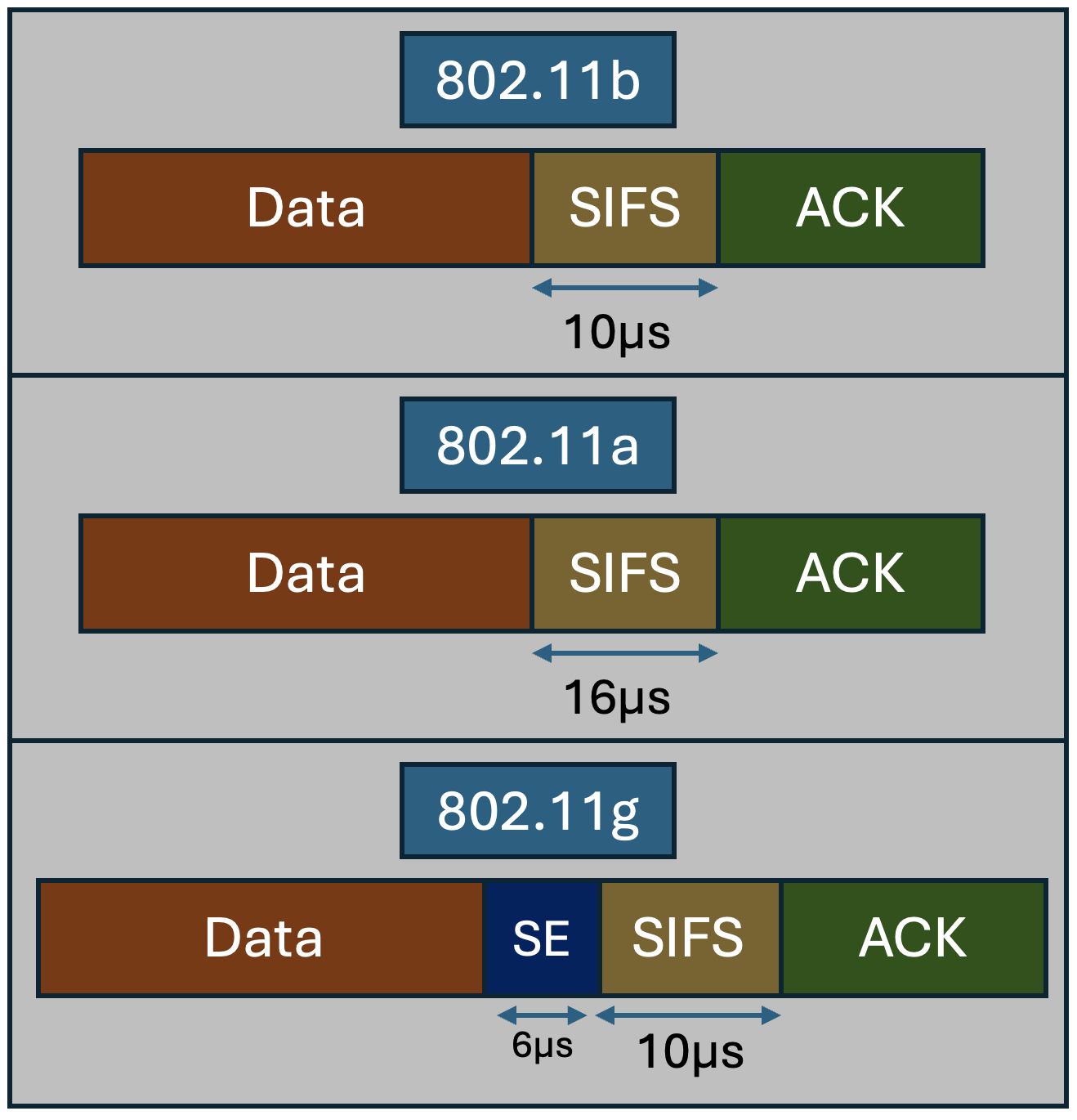
So although the nominal SIFS is still 10µs, the effective processing time available to an 11g receiver is exactly the 16µs that OFDM requires.
How an 802.11b station sees it
From the perspective of an 802.11b station, the 6µs signal extension is simply ignored. It just looks like the medium is busy a little longer, which is enough to keep the two PHYs coexisting cleanly on the same channel.
— Gopi Raga